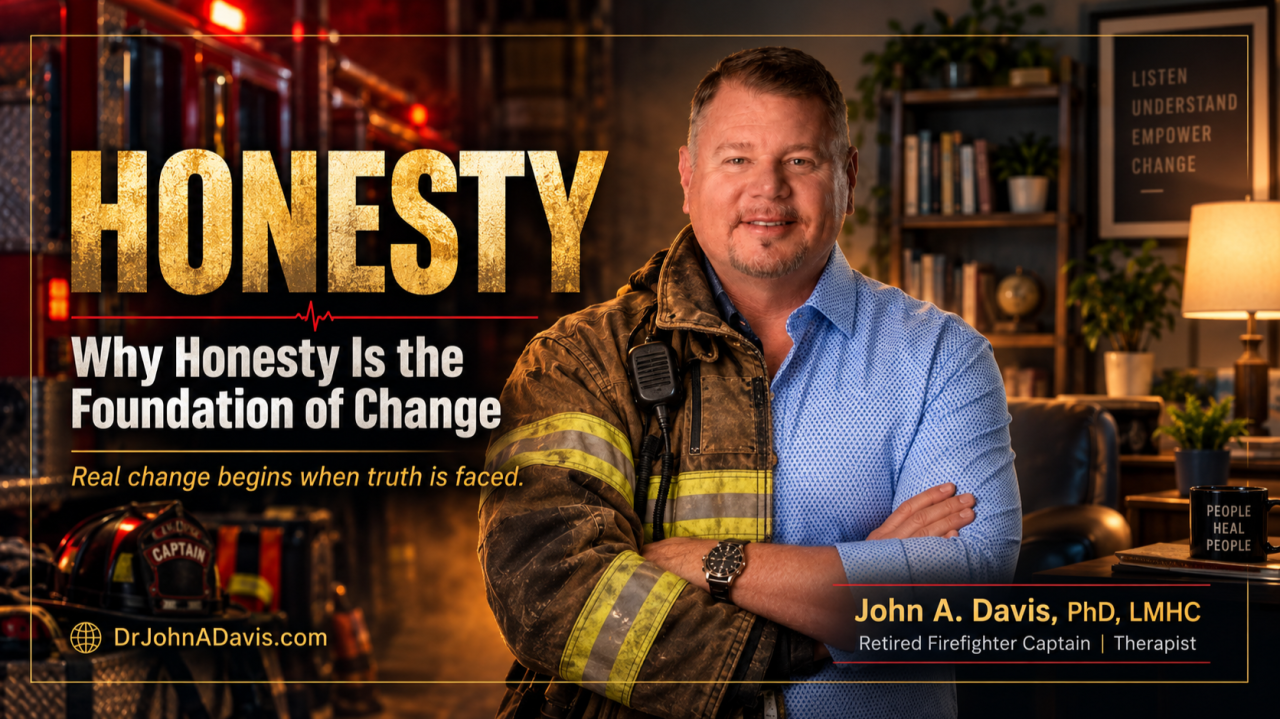
Change does not begin with a plan. It begins with honesty.
Before a person can heal, grow, recover, lead differently, repair a relationship, break a pattern, or become who they were created to be, they first have to tell the truth.
Not the polished truth. Not the comfortable truth. Not the version that protects pride, avoids responsibility, or keeps everyone else from asking difficult questions.
Real change begins when we are willing to say: This is where I am. This is what happened. This is what I have done. This is what I have avoided. This is what I have allowed. This is what I need to face.
Honesty is not always easy. But without it, change is usually temporary.
We Cannot Change What We Refuse to Name
Many people want change without confrontation. They want a better life without naming the patterns that keep damaging it; recovery without admitting the depth of the problem; healthier relationships without acknowledging the harm, distance, resentment, or silence that has grown over time.
They want better leadership without confronting the ways they have avoided conflict, enabled dysfunction, or failed to set a clear standard. They want peace without truth.
But truth is where change begins. A person cannot repair what they keep minimizing. An organization cannot correct what it refuses to measure. A family cannot heal what everyone is afraid to discuss. A leader cannot improve what they keep justifying.
Honesty gives the problem a name. Once something has a name, it can be addressed.
Denial Protects Us Until It Traps Us
Denial is not always intentional. Sometimes it begins as survival. A person tells themselves they are fine because admitting otherwise feels overwhelming. A first responder keeps functioning because the next call is already waiting. A parent keeps going because the family depends on them.
At first, denial may feel protective. It gives us emotional distance, helps us keep moving, and allows us to postpone pain. But eventually, denial becomes a trap.
The problem does not disappear because we refuse to look at it. It grows in the dark. The marriage becomes more distant. The drinking becomes more frequent. The anger becomes more familiar. The anxiety becomes more controlling. The team culture becomes more toxic.
Honesty may be painful, but denial is expensive.
Honesty Is Not Shame
One reason people avoid honesty is because they confuse it with shame. But honesty and shame are not the same. Shame says, “I am bad.” Honesty says, “Something needs attention.” Shame says, “There is no way forward.” Honesty says, “Now we know where to begin.”
Shame hides. Honesty opens the door.
True honesty is not about humiliating ourselves or letting other people define us by our worst moment. It is about seeing clearly. It allows us to accept responsibility without losing hope.
Those statements—I made that choice. I need help. I hurt someone. I have been pretending. I want to do this differently.—are not weakness. They are the beginning of strength.
Change Requires More Than Good Intentions
Most people who need change have already made promises to themselves: I will stop. I will start. I will do better. I will get help. Good intentions matter, but they are not enough.
Honesty asks a deeper question: What keeps happening after the promise?
Repeated patterns reveal something important. If someone wants more time with family but fills every empty space with work, honesty asks why work feels safer than connection. If someone wants to stop drinking but returns to alcohol after stress, honesty asks what pain, fear, loneliness, or discomfort is being medicated.
Change requires us to move beyond what we say we want and examine what we actually do. The pattern tells the truth.
Honesty Builds Trust
Honesty is not only personal. It is relational. Trust cannot grow where truth is constantly managed, hidden, distorted, or delayed.
In families, honesty creates safety. In leadership, it creates credibility. In counseling, it creates the foundation for treatment. In recovery, it creates accountability. In organizations, it creates clarity.
People do not need perfect leaders, spouses, parents, clinicians, or friends. They need people who can tell the truth, accept responsibility, and make the next right decision.
Honesty does not guarantee trust will be restored quickly. But without honesty, trust has very little to stand on.
Honest Change Is Often Uncomfortable
Honesty sounds simple until it costs us something. It may cost pride and comfort. It may require an apology, treatment, a different routine, new boundaries, or a leader finally addressing a problem that has been tolerated too long.
That is why honesty takes courage. Not because truth is complicated, but because truth often requires action. Once we admit the truth, we become responsible for what we do next. That is also where freedom begins.
The Right People Help Us Tell the Truth
We all need people who help us be honest: not people who shame us, excuse everything, or flatter us into staying the same. We need people who can sit with us in truth and still believe change is possible.
A good mentor, counselor, supervisor, sponsor, friend, spouse, pastor, coach, or peer can help us see what we have been avoiding. They can ask better questions, reflect patterns, challenge excuses, and remind us of who we are trying to become.
The right people do not use honesty as a weapon. They use it as a doorway.
Questions That Lead to Change
What am I pretending not to know? What pattern keeps repeating? What have others been trying to tell me? What am I blaming that I actually need to take responsibility for?
Where have I confused functioning with being healthy? What am I avoiding because it feels uncomfortable? Who is affected by my unwillingness to change? What support do I need but have not asked for?
Easy questions rarely change us.
Final Thought
Honesty is the foundation of change because it brings us out of hiding. It allows us to stop performing, pretending, minimizing, blaming, and avoiding. It gives us a clear starting point.
That does not mean honesty fixes everything immediately. It does not erase consequences, make growth painless, or remove the work. But it does make real change possible.
Honesty is where we begin again. Not with perfection. Not with shame. Not with excuses. With truth. And from truth, change can finally become more than a wish. It can become a direction.
Dr. John A. Davis III, PhD, LMHC
Retired Firefighter Captain/Paramedic
Author · Licensed Mental Health Counselor · Speaker