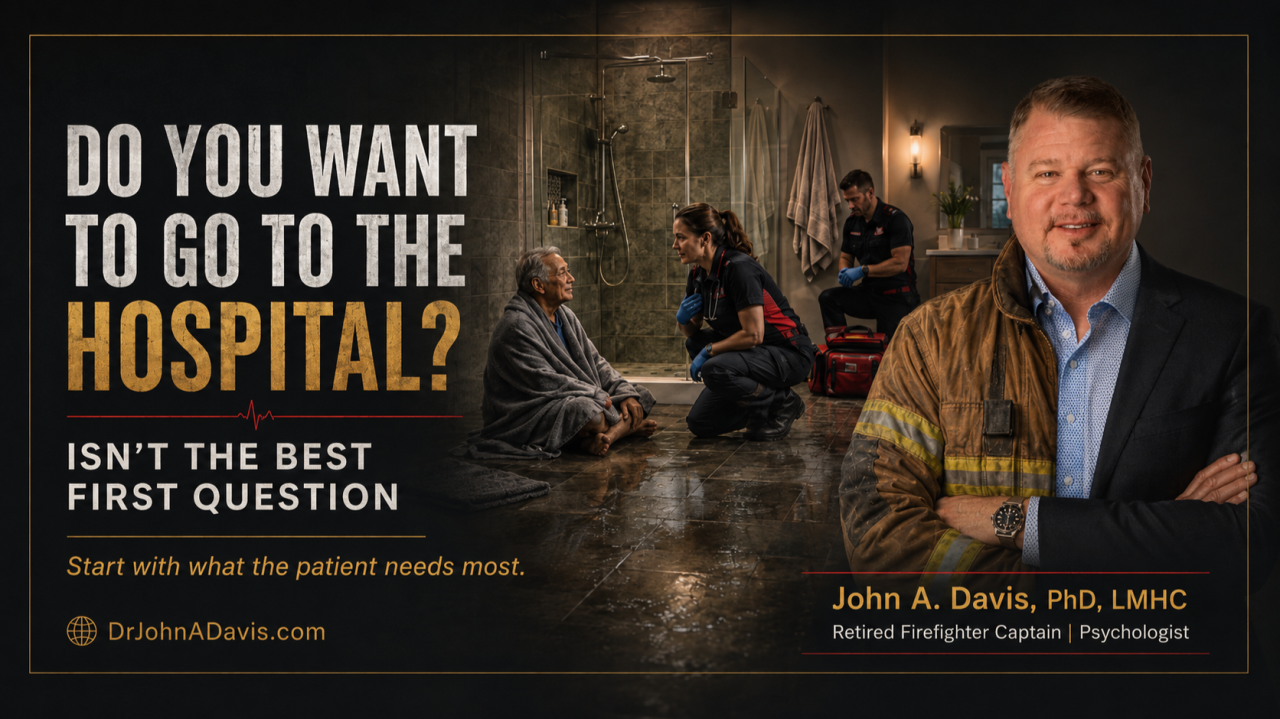
You walk into the bathroom and find your patient lying on the shower floor, soaking wet.
Nobody wants to go to the hospital. That is worth remembering when we ask a patient, “Do you want to go?”
Of course they do not. They want to get dried off, put on clean clothes, get back into their own bed, and have the ambulance leave so their day can return to normal.
But sometimes normal has already left the building.
Before we even touch the patient, that scene has started talking to us. How did they get there? Did they slip, or did they collapse? Did they lose consciousness? Were they dizzy or weak? Did something happen before they fell? Did they strike their head? How long have they been there? Could they get themselves up? Is this someone who normally showers independently? What changed today?
Those questions matter.
The Scene Is Part of the Assessment
Finding a patient on the shower floor is not a diagnosis. It does not automatically mean the patient needs an ambulance ride to the emergency department. But it deserves more thought than, “Do you want to go?”
EMS clinicians have something the patient does not have in that moment: our assessment. We see the environment. We obtain the history. We evaluate mental status, vital signs, medications, mobility, neurological findings, potential injuries, and whatever else the situation requires. We put those pieces together.
Then we should be willing to offer a professional recommendation.
Recommendation Before Preference
There is an important difference between asking, “Do you want to go to the hospital?” and saying, “You were found on the shower floor and could not get yourself up. That concerns me. Based on what we’re seeing, I recommend that you be evaluated at the hospital.”
The patient can still say no. Patient autonomy does not disappear because we believe transport is appropriate. A patient with appropriate decision-making capacity can decline our recommendation.
But informed refusal should actually be informed. If we see something concerning, we need to communicate it. That is not coercion. It is not frightening someone into accepting transport. It is doing the clinical part of the job before asking the patient to make a decision.
Words Carry Weight
Imagine being the patient. You have just been helped off the shower floor by an EMS crew. You are embarrassed, cold, wet, and probably hoping this whole thing will go away. Then a paramedic asks, “Do you want to go to the hospital?”
You may hear something that was never actually said: They must think I’m okay.
That is the problem. Our wording can unintentionally minimize what we just found. A better conversation starts with what we observed, what we assessed, and what concerns us. Then the patient can weigh that information against their own wishes and circumstances.
That is shared decision-making.
Notice What the Environment Is Telling You
Sometimes the most important part of the assessment is not on the cardiac monitor. It is the environment.
The overturned walker. The untouched medications. The family member who says, “She was fine yesterday.” The normally independent patient who suddenly cannot stand. Or the shower that is still running while your patient is lying underneath it, soaking wet and unable to get up.
The scene is giving us information. Our job is to notice it.
Final Thought
Before asking, “Do you want to go to the hospital?” perhaps there is a better question for us to ask ourselves: Why is my patient on the shower floor?
The answer might change the entire conversation.
This article is intended for general professional education and discussion. Patient assessment, treatment, transport decisions, refusals, and documentation should follow applicable protocols, medical direction, scope of practice, and the circumstances of the individual patient.
Dr. John A. Davis III, PhD, LMHC
Retired Firefighter Captain/Paramedic
Author · Licensed Mental Health Counselor · Speaker