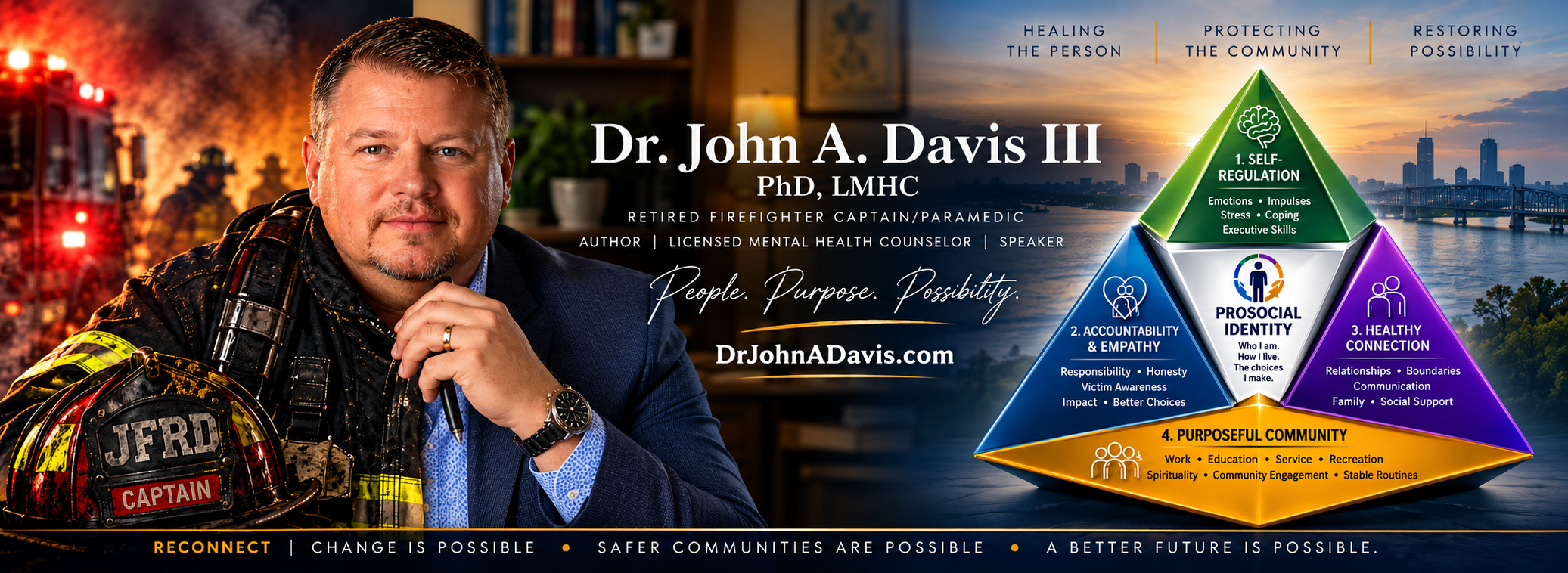
For much of my career, I have worked in professions where people encounter life at its most difficult moments. As a firefighter and paramedic, I responded to emergencies where seconds determined outcomes. Later, as a licensed mental health counselor, I worked with individuals navigating addiction, trauma, mental illness, criminal justice involvement, family conflict, and profound life transitions.
Although these professions appear different, I repeatedly observed the same fundamental question: Why do some people achieve lasting change while others, despite sincere effort, continue to struggle?
Traditional approaches often focus on solving one problem at a time. Treat the addiction. Reduce the symptoms. Complete the program. Finish probation. Attend counseling. Learn a coping skill. Each intervention has value, but lasting behavioral stability rarely develops because of a single intervention.
Human Change Is a System
That realization became the foundation for The Reconnect Systems Model™ (RSM). The model proposes that meaningful, sustainable change emerges not from one protective factor, but from the interaction of multiple protective systems working together.
Rather than asking, “How do we stop this behavior?” Reconnect asks a different question: “What protective systems must be strengthened so healthy behavior becomes increasingly sustainable?”
This shift moves the focus away from pathology alone and toward building a life capable of supporting long-term wellness.
Behavioral Stability Theory
The Reconnect Systems Model™ is grounded in Behavioral Stability Theory, a proposed theoretical framework suggesting that lasting behavioral stability develops through the interaction of multiple protective systems operating within the individual, their relationships, and their community.
Behavior is not viewed as an isolated event. It is understood as an outcome emerging from interconnected systems that continually influence one another. As these systems strengthen and become increasingly integrated, individuals become better equipped to regulate emotions and behavior, make responsible decisions, build healthy relationships, contribute meaningfully to their communities, and sustain long-term behavioral change.
The emphasis is not simply on reducing problems. It is on building stability.
The Four Protective Systems
Self-Regulation
Self-regulation represents our ability to manage ourselves. It includes emotional regulation, impulse control, executive functioning, healthy coping, distress tolerance, stress management, cognitive flexibility, and effective problem-solving. Without self-regulation, healthy intentions often collapse under stress.
Accountability
Accountability represents personal ownership: recognizing choices, accepting responsibility, acting with honesty, learning from mistakes, repairing harm when possible, and making decisions consistent with values and responsibilities. True accountability is not punishment. It is personal integrity in action.
Healthy Connection
Healthy connection reflects the capacity to establish respectful, reciprocal, and emotionally healthy relationships. It includes communication, empathy, trust, healthy boundaries, family relationships, friendship, peer support, and meaningful social connection. Isolation weakens stability. Healthy relationships strengthen it.
Purposeful Community
People thrive when they know they matter. Purposeful community represents meaningful participation in life beyond oneself: employment, education, family, service, faith when personally meaningful, volunteerism, recreation, stable routines, and community involvement. Purpose creates belonging. Belonging strengthens resilience.
The Center: Prosocial Identity
At the center of the Reconnect Systems Model™ lies Prosocial Identity. It is not a fifth Protective System. It is the emergent outcome of the other four increasingly functioning together.
Prosocial Identity answers three simple questions: Who am I? How do I live? What choices define my life? When self-regulation, accountability, healthy connection, and purposeful community become integrated, they gradually shape identity itself. Healthy behavior becomes less about external supervision and more about internal consistency.
Why a Tetrahedron?
The model is intentionally represented by a tetrahedron. The inspiration comes directly from my years in the fire service. Every firefighter learns the Fire Tetrahedron: heat, fuel, oxygen, and a sustaining chemical chain reaction. No single component explains fire; it is their interaction that creates and sustains the system.
Human behavior is infinitely more complex than combustion. The analogy is not intended to equate the two. Instead, the Fire Tetrahedron serves as a conceptual metaphor for systems thinking. Just as fire emerges from interacting conditions, lasting behavioral stability emerges from interacting protective systems.
Beyond Treatment
The Reconnect Systems Model™ is not limited to counseling. Its systems-based approach has potential applications across behavioral health, substance-use treatment, criminal justice, community corrections, first responder wellness, veteran services, leadership development, education, healthcare, and community organizations.
Building Lives, Not Simply Solving Problems
Too often, systems measure success by the absence of negative behavior. Reconnect measures success differently. Success is not merely avoiding relapse; it is building recovery. It is not simply avoiding recidivism; it is building responsibility. It is not simply eliminating crisis; it is creating stability. It is not simply surviving; it is learning to thrive.
A Framework for the Future
The Reconnect Systems Model™ represents more than a theoretical framework. It represents a philosophy of human potential. It challenges us to move beyond fragmented interventions and toward integrated systems that recognize the complexity of human behavior.
Because meaningful change rarely depends upon a single program, skill, or conversation. It develops when protective systems become connected, reinforced, and sustained over time.
That is the vision behind Reconnect: not simply helping people solve today’s problems, but helping them build lives capable of supporting tomorrow’s possibilities.
Dr. John A. Davis III, PhD, LMHC
Retired Firefighter Captain/Paramedic
Author · Licensed Mental Health Counselor · Speaker