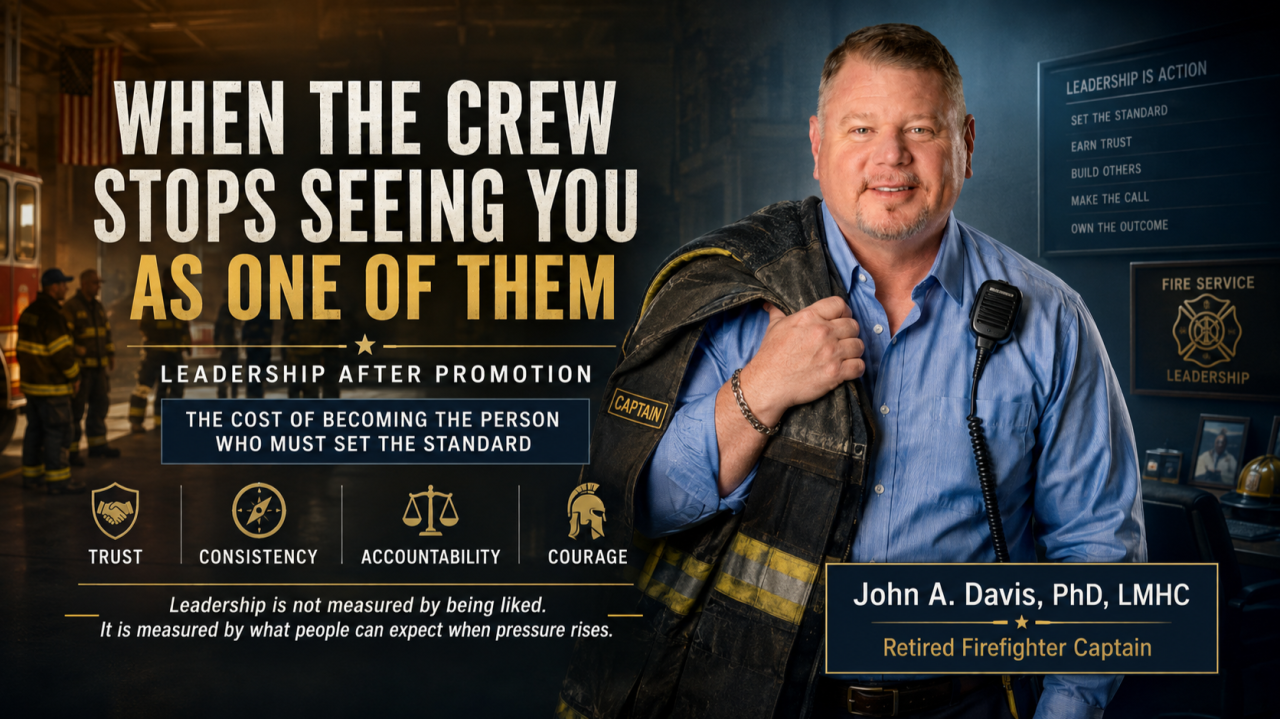
There is a moment after promotion that many new leaders are not fully prepared for.
It may happen at the kitchen table. It may happen in the apparatus bay, the squad room, the briefing room, or after a difficult call.
You walk into a conversation and it stops.
Not because anyone dislikes you. Not because you have changed overnight. But because your role has changed.
Yesterday, you were one of the crew. Today, you are the person who may have to correct them, evaluate them, document their performance, enforce policy, assign work, make unpopular decisions, and answer for what happens when things go wrong.
Promotion changes more than rank. It changes the room.
Friendship and Leadership Are Not the Same Role
In fire, EMS, law enforcement, military, and public safety cultures, relationships are built through shared hardship. You train together. You eat together. You complain together. You survive difficult calls together. You know each other’s families, habits, strengths, weaknesses, and stories.
That bond matters. It creates trust, loyalty, and belonging. But promotion introduces a new responsibility. The person who was once only a peer now has to become a standard bearer.
A new officer may still want to be liked, included, and treated as part of the group. That is human. But leadership cannot be built on the need to remain popular.
When friendship becomes the primary guide, standards become negotiable. When standards become negotiable, trust begins to erode—not all at once, but slowly and quietly, usually through inconsistency.
The Cost of Inconsistency
Crews can forgive a difficult decision. They can respect a leader who holds a line. They can work under pressure when expectations are clear.
What damages trust is inconsistency. One person gets corrected while another is ignored. One shift is held accountable while another gets a pass. One policy matters on Monday but not on Friday. One mistake is handled privately while another becomes public embarrassment.
Inconsistent leadership creates confusion, resentment, and division. People begin asking: Is this about the standard, or is it personal? Does the rule matter, or does it depend on who violated it? Can I trust this leader when the pressure rises?
Promotion does not give a person credibility. It gives them responsibility. Credibility is earned by what the crew sees repeatedly.
The Pressure to Remain Approachable
A new supervisor often feels caught between two fears. If they become too firm, they worry the crew will think they forgot where they came from. If they remain too casual, they risk becoming ineffective.
The goal is not to become distant. The goal is to become dependable.
Approachable leadership does not mean avoiding correction. It means people can come to you because they know you will be fair, consistent, and honest. It means the crew knows you will listen before deciding, and that correction is not humiliation.
But being approachable cannot mean refusing to lead. A leader who avoids every uncomfortable conversation may feel liked in the moment, but the crew eventually pays the price. Small issues grow. Poor habits spread. Resentment builds. Standards weaken.
Private Correction, Public Accountability
One of the clearest signs of mature leadership is knowing what belongs in public and what belongs in private.
Correction should usually happen privately. Humiliating someone in front of others may create compliance, but it rarely builds respect. Private correction allows dignity and gives the person room to hear the message.
But accountability to the standard must be public. The crew should know what matters, what will be expected, and what will not be ignored. They should see that the standard applies across the room, not only to the person easiest to correct.
Correct privately. Set expectations clearly. Apply standards consistently. Own decisions publicly.
Explain the Why Without Surrendering the Role
Public safety professionals do not need leaders who explain every decision until everyone agrees. But they do need leaders who are willing to explain the reasoning behind difficult decisions when appropriate.
People are more likely to accept hard decisions when they understand the principle behind them. “This is not about punishment. This is about safety.” “This is not personal. This is the standard we agreed to follow.” “I understand this decision is unpopular, but here is why it matters.”
Explaining the why does not weaken authority. It strengthens credibility. It shows that the leader is not hiding behind rank, and teaches the crew how to think about standards, risk, professionalism, and responsibility.
The Loneliness of the New Seat
One of the hardest parts of promotion is the quiet loneliness that can come with it. You may still care deeply about the crew. You may still miss the ease of old conversations. You may still want to be included the way you once were.
But leadership changes access. There are things you can no longer say casually, conversations you can no longer participate in the same way, and decisions you cannot make based only on friendship.
That does not mean you have betrayed the crew. It means you have accepted a different form of service. Leadership is service, but it is not always comfortable service. Sometimes it means being misunderstood. Sometimes it means choosing what is right over what is easy.
The Standard You Set Becomes the Culture You Create
Every leader creates culture—not only through policy, speeches, or formal expectations. Culture is created in the daily details: what you tolerate, what you correct, what you praise, what you ignore, how you speak under pressure, how you handle mistakes, and how you treat the person who is struggling.
Crews study leaders closely. They learn what matters by watching what leaders actually do. The standard is not what is printed in a manual. The standard is what the leader consistently reinforces.
Being Liked Is Not the Goal
Most leaders want to be respected. Many also want to be liked. There is nothing wrong with that. But being liked cannot become the measure of leadership.
Some of the best decisions a leader makes will not be popular at first. Some of the most necessary corrections will disappoint people. Some of the clearest standards will frustrate those who preferred ambiguity.
Effective leadership is measured by whether people know what to expect when the pressure rises. Can the crew trust your judgment? Can they predict your standards? Can they believe you will be fair? Can they count on you to tell the truth? Can they follow you when the situation becomes difficult?
Final Thought
Promotion changes the way people see you. The jokes may change. The conversations may become guarded. The invitations may slow down. The room may feel different when you walk in.
But the goal of leadership is not to keep every relationship exactly as it was before. The goal is to become worthy of the responsibility you have been given.
You can still care about your people. You can still listen. You can still be human. You can still remember where you came from. But you must also set the standard.
Because when the call gets difficult, when the scene gets chaotic, when emotions rise, when performance matters, and when safety is on the line, the crew does not need a leader who is trying to be everyone’s friend. They need a leader they can trust.
And trust is built through consistency, courage, humility, and the willingness to do the hard parts of leadership before the pressure rises.
Dr. John A. Davis III, PhD, LMHC
Retired Firefighter Captain/Paramedic
Author · Licensed Mental Health Counselor · Speaker