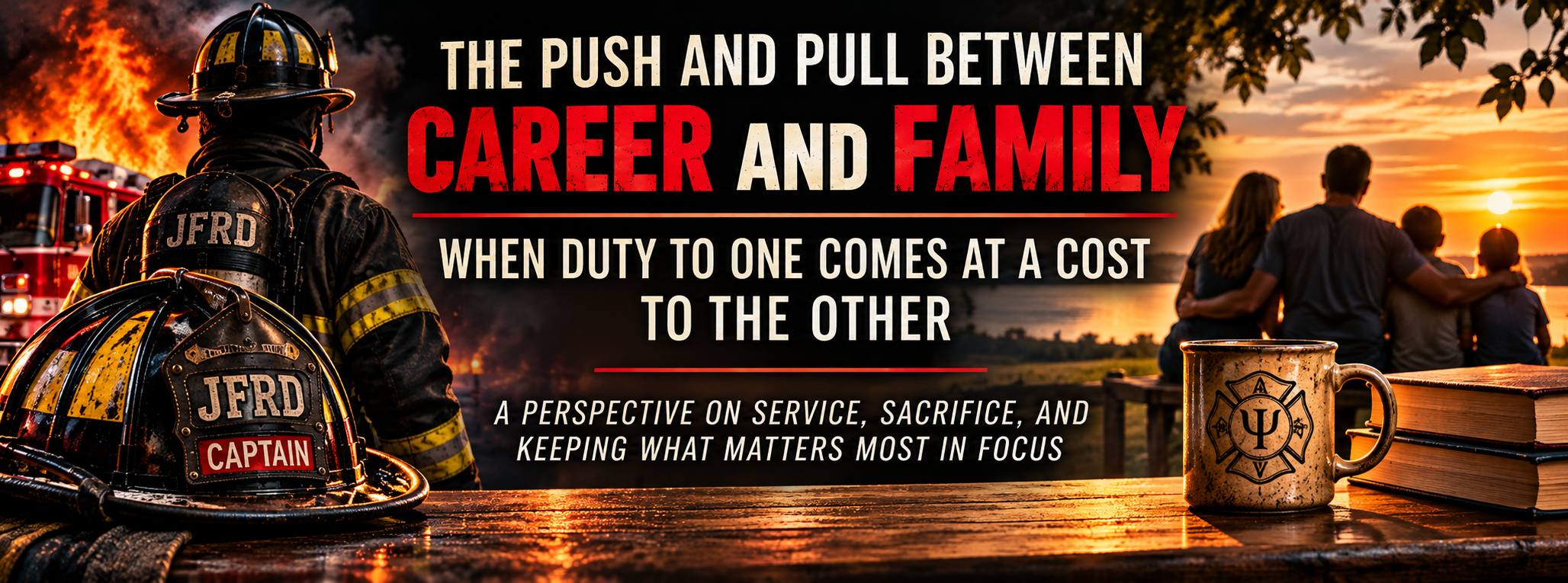
There is a particular kind of exhaustion that comes from trying to be everything your career demands while still being the person your family needs.
For those who have spent their lives in demanding professions, especially firefighting, emergency medical services, law enforcement, healthcare, and other public-service careers, the conflict between professional responsibility and family life is familiar. It is a struggle that rarely receives the attention it deserves.
We talk about work-life balance as though it is a matter of scheduling. We suggest better time management, setting boundaries, and making family a priority. Those are reasonable suggestions, but they often fail to acknowledge the deeper conflict.
Sometimes, the problem is not a lack of priorities. It is having two sets of responsibilities that matter deeply, both demanding something from you at the same time.
And sometimes, regardless of what you choose, someone pays a price.
The Career That Becomes Part of Who You Are
In the fire service, the job has never been simply a paycheck. It provides purpose, identity, belonging, and a sense of responsibility that is difficult to explain to someone who has never worked in that environment.
The firehouse becomes a second home. The people beside you become an extended family. You share experiences that create powerful bonds, often under circumstances most people will never encounter.
Over time, the line between what you do and who you are begins to disappear. There is pride in being dependable, in showing up when others need help, and in accepting responsibilities that come with serving your community.
But that same commitment can create problems at home. The qualities that make someone a valued firefighter, officer, supervisor, or professional are not always the qualities that sustain a healthy family relationship.
At work, you may be rewarded for putting personal needs aside, suppressing emotions, and remaining focused on the mission. At home, your family may need you to do precisely the opposite. They need emotional availability, patience, conversation, and a willingness to be vulnerable. Making that transition is not always easy.
The Family That Learns to Live Around the Job
One of the more difficult realities of a demanding career is that the family often makes sacrifices that never appear in a performance evaluation or retirement record. There are missed birthdays, holidays, school activities, anniversaries, and ordinary evenings that cannot be recovered.
But the impact extends beyond missed events. There is the spouse who learns to manage household responsibilities alone because schedules are unpredictable. There are children who become accustomed to a parent being absent during important moments. There are family plans repeatedly adjusted around overtime, shift changes, emergencies, and professional obligations.
Eventually, the household develops a rhythm around the career. The family adapts because it has to. What concerns me is how easily that adaptation can be mistaken for acceptance.
A spouse who stops complaining about missed family events may not have stopped caring. They may have simply grown tired of expressing disappointment. A child who no longer asks whether you will attend a school function may have learned not to expect you.
A family can become very skilled at functioning around someone's absence without becoming comfortable with it. That distinction matters.
Physically Home, Mentally Somewhere Else
Being present at home does not always mean being emotionally available. In demanding professions, particularly those involving repeated exposure to emergencies, conflict, suffering, and loss, the mind does not necessarily leave work when the shift ends.
A firefighter may return home exhausted after a difficult tour. A police officer may remain mentally alert and guarded after hours of uncertainty. A healthcare professional may struggle to stop thinking about decisions made during a challenging shift. Even those in administrative and leadership positions may carry the weight of personnel problems, organizational responsibilities, and difficult decisions long after leaving the workplace.
The family sees someone who is home. But that person may be withdrawn, irritable, distracted, or emotionally distant. Sometimes silence becomes the easiest option, not necessarily because the individual does not care, but because conversation requires emotional energy that feels unavailable.
Unfortunately, family members cannot always distinguish between exhaustion, occupational stress, and disinterest. They only experience the distance. Over time, repeated emotional absence can become just as damaging to a relationship as physical absence.
The Guilt That Exists on Both Sides
When you are at work, you may feel guilty about what you are missing at home. When you are at home, you may feel guilty about what is happening at work. You wonder whether your crew needs you, whether a problem has been resolved, or whether someone else is carrying a responsibility you should be handling.
Meanwhile, your family may be asking for something that seems simple: your attention. You want to be a good spouse, parent, and professional. You want to provide financial security and demonstrate the work ethic you believe matters. You want your family to be proud of what you have accomplished. But you also want to be present for the moments that build relationships.
Career opportunities often arrive with a sense of urgency. Promotions, additional responsibilities, specialized assignments, and leadership positions may feel like opportunities that cannot be passed up. Family relationships develop differently. They are built through ordinary interactions, repeated conversations, shared experiences, and the reliability of being there.
Careers often recognize major accomplishments. Families remember patterns of presence and absence. Both matter, but they measure commitment differently.
When Providing Becomes a Substitute for Participating
Many hardworking professionals genuinely believe that their sacrifices are primarily for their families. They accept overtime, additional assignments, promotions, and increasing responsibilities because they want to provide a better life. And often, that motivation is sincere.
Financial stability matters. Providing opportunities for children matters. Creating a secure home matters. But there can come a point when providing becomes easier than participating.
Working additional hours may feel more manageable than addressing tension in a marriage. Professional responsibilities may offer clearer expectations than the emotional complexity of raising children. At work, problems are often met with action plans, decisions, and measurable outcomes. At home, some problems require listening without immediately trying to fix anything.
That can be difficult for people whose professional identities have been built around solving problems and maintaining control. A family needs financial security, but it also needs connection. One cannot consistently replace the other.
Leadership Comes With a Responsibility We Rarely Discuss
Having spent a career in the fire service and working in behavioral health, I believe organizational leadership has an important role in this discussion. We cannot continually praise employees for sacrificing everything for the job while treating the consequences to their families as entirely personal problems.
There will always be emergencies, staffing challenges, operational demands, and circumstances requiring people to place professional obligations ahead of personal plans. That is part of public service. But organizational culture influences how those demands are managed.
Leaders send powerful messages through what they reward, what they tolerate, and how they respond when employees experience family difficulties. When excessive overtime becomes a badge of honor, people may begin to associate exhaustion with dedication. When taking leave for family responsibilities is viewed as a lack of commitment, employees learn to conceal those needs.
Good leadership requires recognizing that employees have lives beyond the workplace. A firefighter who maintains a healthy family relationship is not less committed to the profession. A supervisor who respects reasonable boundaries is not demonstrating weakness. And an organization that supports the families of its employees is making an investment in the people who sustain its mission.
We should be careful not to confuse unlimited availability with genuine professional dedication.
The Difficult Reality of Retirement
There is another dimension to this struggle that often becomes apparent only after the career ends. For years, family life may have revolved around the demands of the profession. Then retirement arrives. The schedules change. The radio stops calling. The station is no longer a daily destination. The professional identity that shaped so much of life begins to shift.
Suddenly, the person who was frequently absent is home. But physical availability does not automatically create emotional closeness. Relationships that have adapted to years of separation may require a period of adjustment.
A spouse may have developed routines and independence that do not easily accommodate a new daily presence. Adult children may have established relationships with a parent based largely on limited availability. And the retired professional may discover that leaving the career is easier than understanding who they are without it.
Retirement can expose relationship patterns that were previously hidden beneath busy schedules. That does not mean those relationships are beyond repair. It means that the transition deserves more preparation than simply calculating a pension and choosing a retirement date.
We need to prepare emotionally and relationally for retirement, not just financially.
Finding a More Sustainable Way Forward
I do not believe there is a perfect formula for balancing career and family. Some professions will always involve missed moments, unexpected absences, and competing demands. The goal should not be to eliminate every conflict. That is unrealistic.
The goal is to recognize the conflict before it becomes a permanent pattern of disconnection. That begins with honest conversations. Families need opportunities to express how professional demands affect them without every concern becoming an argument about the importance of the job.
Professionals need to acknowledge that being a good provider does not automatically mean they are meeting every emotional need at home. Couples need to talk about expectations, frustrations, and the sacrifices each person is making. Parents need to recognize that children may not understand why the job always seems to come first. And leaders need to examine whether workplace expectations unnecessarily contribute to those difficulties.
Sometimes the most meaningful changes are relatively small: protecting time together when possible; putting the phone aside during family conversations; being emotionally engaged rather than simply occupying the same room; recognizing when occupational stress is affecting behavior at home; and seeking professional support when communication becomes strained or emotional withdrawal becomes an established pattern.
Perhaps most importantly, relationships require ongoing attention, not simply good intentions.
The People Waiting at Home
There is tremendous honor in choosing a career dedicated to serving others. I would never diminish the commitment required of firefighters, paramedics, police officers, healthcare professionals, or others who accept demanding responsibilities.
But there is also honor in recognizing the needs of the people who support that commitment. The family waiting at home does not wear the uniform, respond to the emergency, or receive the professional recognition. Yet they often share the burden.
They live with the schedules, uncertainty, fatigue, interrupted plans, and emotional consequences that accompany the work. Their sacrifices deserve acknowledgment.
As professionals, we may spend years learning how to become better at our jobs. We attend training, pursue certifications, accept leadership responsibilities, and work to develop our skills. We should be willing to devote some of that same intention to becoming better spouses, parents, and family members.
Not because professional commitment is wrong, but because our responsibilities do not end when we leave the workplace. A successful career can provide a lifetime of pride. But the relationships we maintain along the way help determine what that success ultimately means.
The push and pull between career and family may never disappear completely. What matters is whether we recognize it, talk about it, and make deliberate choices before the distance becomes something we no longer know how to close.
John A. Davis III, PhD, LMHC
Retired Firefighter Captain/Paramedic
Author · Licensed Mental Health Counselor · Speaker