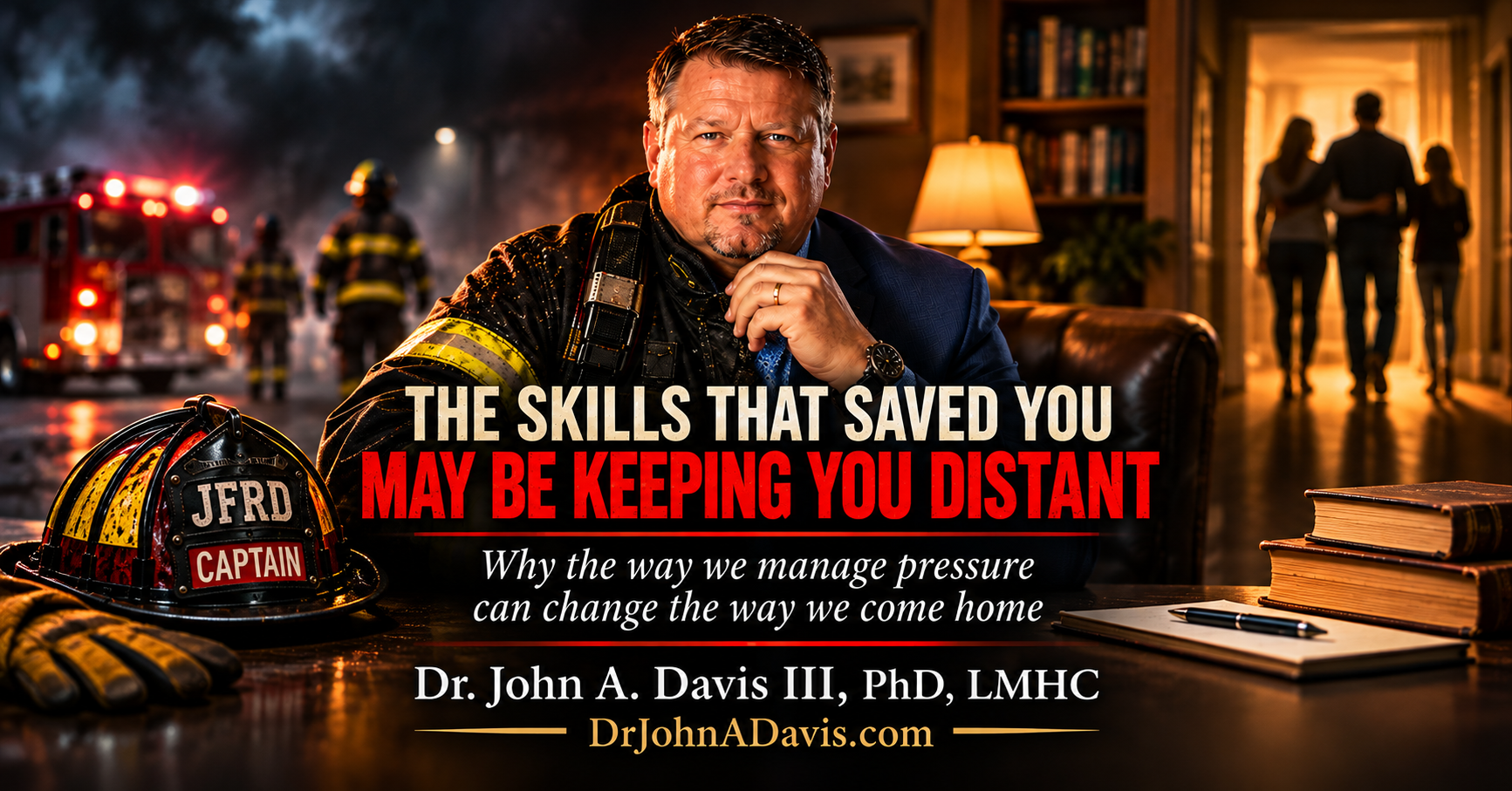
On the fireground, staying calm can help you make the next decision. In a counseling session, staying composed can help another person feel safe enough to speak. In a classroom, an internship, or any demanding profession, pushing through uncertainty can help us learn when we are afraid of getting something wrong.
These are valuable skills. They help us serve, lead, learn, and care for others.
But what happens when the habits that help us perform under pressure follow us into every other part of life? What happens when composure becomes silence, independence makes it difficult to accept help, or the ability to focus on everyone else leaves little room to recognize what we need?
The people closest to us may not see the effort it takes to hold everything together. They may only experience the distance.
The transition no one talks about
As a firefighter, I learned that an emergency requires attention. You assess what is happening, rely on your training, and make the best decisions you can with the information available. There is a time to focus on the task in front of you and set aside your own reactions so you can help someone else. That ability matters.
But the end of a call does not come with a switch that immediately returns you to the person you were before it began. The same is true at the end of a difficult shift, a demanding counseling session, a long day of school, or a conversation in which someone depended on you to remain strong.
You can walk through the front door and still be carrying the demands of the day.
Your spouse asks how your shift went. You say, “Fine.” A friend asks whether something is bothering you. You say, “I’m just tired.” A supervisor asks an intern whether they need help. They say, “I think I have it.”
Sometimes those answers are accurate. Sometimes they are simply the easiest words to reach for when we do not yet know how to explain what is happening inside.
When a strength becomes a barrier
In The Fire That Followed Me Home, I explore the reality that experiences do not always stay where they occurred. They can follow us into our homes, relationships, and sense of who we are.
Sometimes what follows us home is a single difficult memory. At other times, it is a pattern we have practiced so often that we no longer notice it.
A first responder learns to assess a situation quickly. At home, that same person may begin solving a family member’s problem before taking time to listen. A clinician learns to attend closely to the needs of others, yet may struggle to say, “I need someone to listen to me.” A student or intern learns to demonstrate competence, and over time may begin to experience a question as an admission of inadequacy rather than a responsible part of learning.
The skill itself is not the problem. The question is whether we recognize when it is helping us and when the moment requires a different response.
The people closest to us may experience our coping before they understand it
A person may become quiet because they are trying to settle after a difficult day. Their spouse may experience that quiet as rejection. A clinician may leave work emotionally tired and need a few minutes alone. A friend may interpret the lack of conversation as disinterest. An intern may hesitate to ask for guidance because they do not want to appear unprepared, while a supervisor assumes they are comfortable with the assignment.
What one person intends and what another person experiences may be very different. The space between those perspectives is where misunderstanding grows.
We do not need to share every detail to bridge that space. Sometimes a simple explanation is enough:
“I’m quiet because I need a few minutes to settle after today. I’m not upset with you.”
“I want to listen, but I notice I’m going straight into problem-solving. Would it help if I just listened?”
“I’ve been trying to work through this on my own, but I could use some guidance.”
These statements may seem small. They give another person a more accurate understanding without asking them to guess.
The scene and the aftermath
In Fireline Protocol, emergency response provides a setting where decisions carry weight and pressure reveals character. Fiction gives us room to consider not only what a character does when the immediate demand is clear, but what remains after the urgency passes.
Real life is often less dramatic in appearance. The aftermath may look like sitting in a driveway for a few extra minutes before going inside. It may look like scrolling through a phone while someone nearby is trying to start a conversation. It may look like saying yes to another obligation when you are already exhausted.
These moments do not automatically mean someone is struggling with trauma or a mental-health condition. They may simply be signals worth noticing. The goal is not to diagnose ourselves or each other; it is to become curious about our patterns instead of moving through them without awareness.
Reconnection begins with honesty
The Reconnect System begins with a simple belief: lasting change requires an honest look at our thoughts, choices, and relationships. Honesty is not only what we tell other people. It is also a willingness to tell ourselves the truth.
That may mean acknowledging:
- “I am more tired than I have admitted.”
- “I have been answering questions at home as if I am still giving directions at work.”
- “I keep helping everyone else because I am uncomfortable asking for help.”
- “I said I was fine because I did not know how to explain what I was feeling.”
- “I have been so focused on proving I can do this that I have stopped allowing myself to learn.”
An honest observation does not require shame. It gives us a place to begin. When we can recognize that a response is creating distance, we have an opportunity to choose something different. We may still need quiet, time to process, or help. But we can communicate those needs in a way that supports connection.
A practical pause
The next time you notice yourself withdrawing, becoming defensive, or immediately trying to fix a problem, take a brief pause and ask:
- What am I carrying into this moment? Consider whether fatigue, frustration, worry, or the demands of the day are shaping your response.
- What does this situation actually need from me? Does it call for a decision, a listening ear, a question, a boundary, or a few minutes to transition?
- What might the other person be experiencing? Your silence may feel like rest to you and uncertainty to someone else. Your advice may feel helpful when the other person needs to feel heard.
- What can I communicate honestly? You do not need a perfect explanation. One clear sentence can be a starting point.
This pause will not resolve every disagreement or erase the effects of a demanding career. It can, however, create an opportunity to respond with more awareness.
For students and interns: you are allowed to be learning
If you are beginning a career in counseling, emergency services, healthcare, or another helping profession, the pressure to appear capable can arrive early. You may believe everyone else understands more than you do, or worry that asking for clarification will make someone question whether you belong.
But the purpose of training and supervision is learning. Asking a thoughtful question demonstrates your commitment to doing the work responsibly. You can develop confidence while remaining open to guidance. You can learn to support others while also recognizing your own limits.
For the people who care about helpers
If someone you love works in a demanding or helping profession, you may not always know what they are carrying. At the same time, their need for space does not make your need for connection unimportant. Both deserve attention.
A helpful conversation might begin with curiosity: “I notice you’ve been quiet when you get home. Would some time to yourself help, or would you like to talk?” Or: “When we don’t talk, I sometimes worry I’ve done something wrong. Can we find a way to let each other know what we need?”
The purpose is not to force a disclosure or find perfect words. It is to make room for an honest conversation.
Bringing the whole person home
The qualities developed through service can remain part of who we are. Composure, courage, attentiveness, responsibility, and commitment to others have value far beyond the workplace. But none of us is only a role.
A firefighter is also a spouse, parent, friend, or neighbor. A clinician is also a person who needs support. A student is more than a grade or evaluation. An intern is more than what they have yet to learn.
Reconnection begins when we give ourselves permission to be present as a whole person, including the parts that are uncertain, tired, hopeful, and still growing.
The skills that helped you through difficult moments deserve respect. So do the relationships waiting for you when those moments are over.
John A. Davis III, PhD, LMHC
Retired Firefighter Captain/Paramedic
Author · Licensed Mental Health Counselor · Speaker