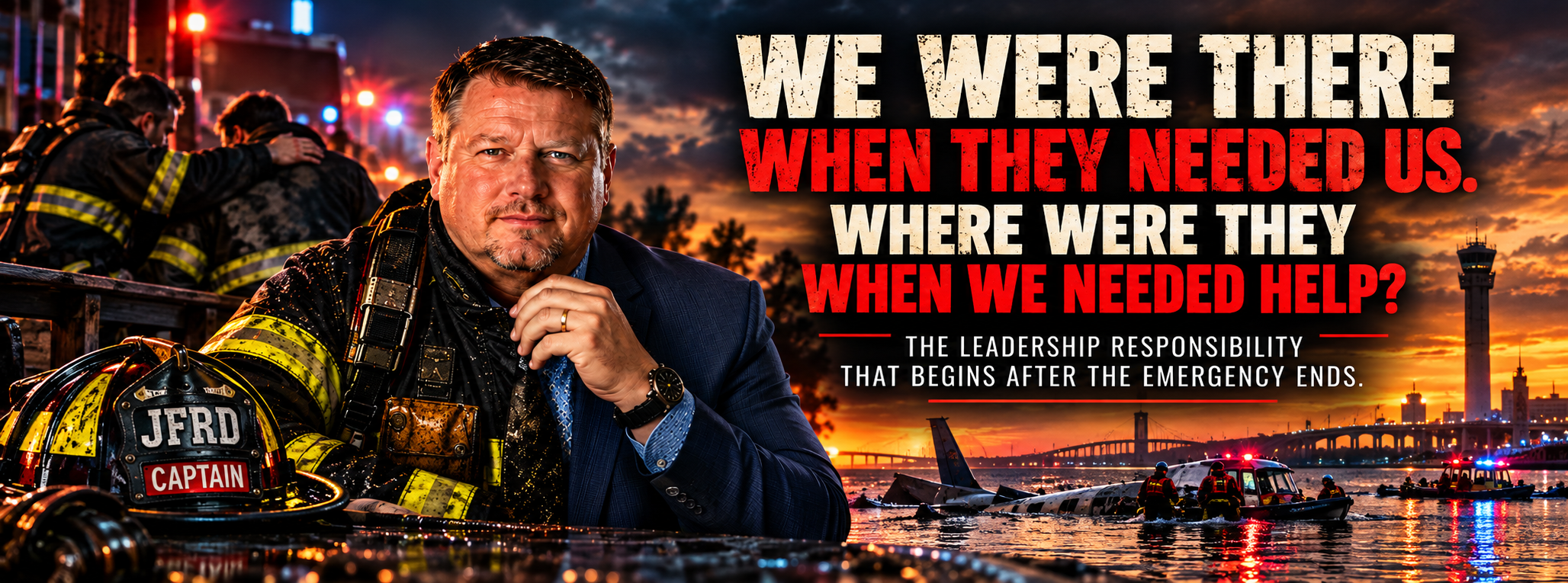
There is an unwritten promise in the fire service.
When you enter a burning building, somebody has your back. When you call a Mayday, somebody is coming. When the situation becomes overwhelming, you are not supposed to face it alone.
We build our training, tactics, and operational culture around that promise. We teach firefighters to trust their crews, their officers, and the systems designed to protect them.
But I have a question.
Does that promise still apply when the emergency is over and the firefighter is the one who needs help?
A recent report involving firefighters who responded to the January 2025 midair collision near Reagan National Airport raises that question in a way every fire chief, company officer, and firefighter should consider. And I believe the conversation is long overdue.
When the Emergency Ends, the Consequences May Just Be Beginning
On January 29, 2025, an American Airlines regional jet and a U.S. Army helicopter collided over the Potomac River, killing 67 people. Firefighters and other emergency personnel responded to an extraordinarily difficult scene.
On October 14, 2026, The Washington Post reported on an internal memorandum written by an Arlington County fire captain describing concerns about the department's response and the support provided to personnel afterward.
According to the reporting, the memorandum raised concerns about leadership presence, communication, access to continuing mental health treatment, and firefighters who reportedly feared professional consequences for speaking openly about their experiences.
The Arlington County Fire Department responded publicly, explaining that it had provided peer support, clinician outreach, incident debriefing, referrals, and other wellness services. The department also identified broader obstacles to accessing sustained mental health care, including provider availability and limitations within Virginia's workers' compensation system.
These are competing accounts of an important issue, and it would be irresponsible to draw conclusions about individual leaders without knowing all the facts. But the larger question does not depend on assigning blame.
How can an organization have behavioral health resources available and still have employees who feel unsupported?
That question deserves serious attention.
A Program Is Not the Same as a Culture
I spent much of my professional life in the fire service, eventually retiring as a Firefighter Captain/Paramedic. I also work as a Licensed Mental Health Counselor. Those two careers have given me different perspectives on the same problem.
From the fireground, I understand the importance of structure, operational discipline, chain of command, and accountability. From the clinical side, I understand that exposure to potentially traumatic events does not produce the same response in every person.
Some firefighters experience distress immediately. Others may not recognize meaningful changes until weeks or months later. Some never develop a clinical disorder but still struggle with sleep, irritability, relationships, concentration, or the emotional weight of what they have experienced. Others need specialized treatment.
There is no single timetable for recovery. And there is certainly no guarantee that an employee will be fine because a department offered a debriefing or provided a telephone number for counseling.
A department can have an employee assistance program, a peer-support team, a wellness officer, and a beautifully written behavioral health policy. Those resources matter. But they do not automatically create trust.
Trust is established when firefighters believe they can ask for help without being judged, punished, marginalized, or treated as professionally unreliable.
That belief develops over years of watching how leaders respond to people who are struggling. It cannot be created by policy alone.
The Firehouse Table Tells You More Than the Policy Manual
One of the most revealing places in a fire station is the firehouse table. That is where firefighters talk about leadership. They discuss who showed up, who followed through, who listened, and who disappeared when things became uncomfortable.
They also remember how the department treated the last firefighter who admitted having a problem. Was that person supported? Was confidentiality respected? Were they given reasonable opportunities to obtain treatment and return to work? Or did asking for help become something they regretted?
Those observations shape whether the next firefighter speaks up. As officers, we sometimes underestimate how closely our personnel watch our behavior.
Organizational culture is not what leadership says it values. It is what employees repeatedly experience.
Five Responsibilities That Cannot End at the Incident Scene
I believe fire service leadership should approach significant potentially traumatic incidents with the same seriousness given to operational planning. That means establishing clear responsibilities before the incident occurs.
1. Be present when it matters.
Leadership presence should not be limited to operational oversight. Firefighters need to know their officers recognize the human demands of difficult assignments. Leaders must establish visible, credible systems of support and remain accountable for how those systems function.
2. Follow up beyond the first few days.
Immediate support is important, but a single conversation cannot predict someone's long-term needs. Follow-up should remain available over time, with opportunities for confidential assessment and referral when appropriate.
3. Make professional treatment genuinely accessible.
Giving someone a counseling referral is not the same as ensuring they can obtain care. Are qualified providers available? Do they understand public safety culture? Can the firefighter afford the recommended treatment? Are insurance restrictions, workers' compensation procedures, or scheduling barriers interfering with care?
4. Protect confidentiality and professional dignity.
Firefighters must understand the boundaries of confidentiality, including legitimate safety-related exceptions. They should also know that seeking appropriate mental health care does not automatically mean they are incapable of doing their jobs. Silence should never be mistaken for wellness.
5. Measure outcomes, not just activities.
It is easy to report peer-support contacts, presentations, or referrals. Those are useful measures of activity. Leadership should also evaluate whether employees can obtain timely care, whether follow-up is effective, whether barriers are being resolved, and whether personnel trust the process.
The goal is not to prove that the department has a program. The goal is to make sure the program actually helps the people it was created to serve.
The Company Officer Has a Responsibility, Too
This conversation cannot begin and end with the fire chief. Company officers have an enormous influence on how firefighters experience their organizations. A captain may be the first person to notice that a dependable firefighter has become withdrawn, unusually irritable, distracted, or disconnected from the crew.
Those observations do not establish a diagnosis. They are reasons to pay attention and, when appropriate, have a private conversation.
Sometimes that conversation begins with something as simple as: “I've noticed you haven't seemed like yourself lately. How are things going?”
The officer does not need to become a therapist. The officer's responsibility is to recognize concerns, listen without judgment, maintain appropriate boundaries, connect the firefighter with qualified support, and follow through within those boundaries.
Leadership does not require having every answer. It requires refusing to ignore the questions.
We Cannot Expect Firefighters to Carry Everything Alone
The fire service has made meaningful progress in acknowledging behavioral health. Conversations that were once avoided are now taking place in recruit academies, officer development programs, conferences, and firehouses across the country. That progress matters.
But awareness is only the beginning. The next challenge is making sure that the organizational response matches the message.
We tell firefighters to recognize their limitations, request additional resources, and never hesitate to call for help when conditions deteriorate. Why should those principles be different when the problem involves psychological distress?
We need to build organizations where requesting appropriate help is viewed as responsible behavior, not a personal failure. That requires leadership, accountability, access to qualified care, and a willingness to examine uncomfortable truths. It also requires acknowledging that even well-intentioned programs can fall short.
The Promise Should Not Expire
I have always believed that leadership is measured most clearly when circumstances become difficult. It is relatively easy to lead when morale is high, the calls are routine, and everything is going according to plan. The real test comes when people are exhausted, injured, discouraged, or uncertain about what comes next.
Firefighters are expected to answer when the community calls. They respond at two in the morning, in freezing weather, in dangerous conditions, and in circumstances most people will never have to witness. They accept extraordinary responsibilities.
But accepting those responsibilities should never mean surrendering the right to appropriate care and organizational support.
We spend entire careers teaching firefighters that nobody gets left behind on the fireground.
That promise should not expire when the incident commander declares the emergency over.
Because sometimes the firefighter who needs rescuing is the one who spent a career rescuing everyone else. And leadership must be prepared to answer that call, too.
A Question for the Fire Service
What did your department do after a particularly difficult incident that made you feel genuinely supported, or left you feeling forgotten?
I would especially welcome perspectives from firefighters, company officers, chiefs, peer-support personnel, and behavioral health professionals. These conversations are worth having, and they may help us build better systems for the next generation.
Dr. John A. Davis III, PhD, LMHC
Retired Firefighter Captain/Paramedic
Author · Licensed Mental Health Counselor · Speaker